Bench, Ledge or Low Wall: Three Places to Pause
Bench, ledge or low wall: learn how each sitting place shapes a public-space pause, from a brief perch to a longer, more settled stop.
The common mistake with a bench, ledge or low wall is to treat them as interchangeable bits of spare seating. That misses what each one invites: a short perch, a shared stop, or a pause with a view. Notice those differences and a public space becomes easier to read—not just as a route through town, but as a place where different kinds of rest can happen.
Bench, ledge or low wall: each offers a distinct invitation. The difference lies in more than comfort. Back support, edges, height, position and what happens nearby all affect who can use a spot, how long they might stay, and whether the pause feels private, sociable or simply convenient.
What kind of pause does a bench invite?
A bench usually suggests that someone may settle in. Its seat is made for sitting, and a backrest can support a longer rest. If it has arms, those may help someone sit down or stand up, while also dividing the bench into places that can be awkward to share. A bench is not automatically welcoming, but it tends to make its purpose clear.
Its position changes the feel. A bench facing a path lets a person watch people pass; one angled towards a garden, water or a play area gives the eyes somewhere to rest. A seat beside a busy crossing may be handy for waiting, but less appealing for a leisurely pause if movement, noise or bicycle traffic presses close.
Notice who can use the whole seat. A broad bench may accommodate companions, while a central armrest can make sitting with a child or carrying a bag less straightforward. A seat with a clear transfer space beside it may be easier for someone using a mobility device to approach, although the surrounding route and surface matter too. A bench that is available in theory but hemmed in by bins, café chairs or parked bicycles can be difficult to reach.
Benches also set a social tone. People can face one another, sit shoulder to shoulder or look out in the same direction. That can make a bench useful for conversation, waiting or watching a shared scene. If the seat faces another bench across a narrow path, though, strangers may feel uncomfortably on display; a small turn in the seating can soften that encounter.
Why does a ledge feel like a shorter stop?
A ledge often asks for less commitment. It may be a broad stone edge beside a planter, a low sill around a fountain, or a built-in rim where people can perch briefly. With no backrest and often no arm support, it suits a quick rest, a conversation between errands, or a moment spent setting down a bag while checking a map.
That informality can be useful. A ledge does not always require someone to claim an entire seat, and people can sit at different points along it. Friends can gather without arranging themselves around a formal table; a person alone can perch at one end and leave room for someone else. Yet a narrow, sloping or rough surface may be uncomfortable, and the absence of a backrest can make it a poor option for anyone who needs more support.
Look at what the ledge belongs to. A planter edge may offer shade and greenery, but branches, soil or irrigation fittings can take up the usable surface. A fountain rim may attract people because it gives them something to watch, while splash, damp stone or a crowded edge changes the experience. These details are not decoration around the seating; they decide whether it works as a place to pause.
A ledge can also blur the line between sitting and occupying a feature designed for another purpose. People may perch on a low wall around a tree without damaging it, but a narrow cap above a fragile planting bed is another matter. The material, shape and signs on site offer clues about what is intended. Where access or local rules are unclear, follow the posted guidance rather than assuming every flat surface is a seat.
When does a low wall work better than a seat?
A low wall can make the edge of a public space useful. It may separate a plaza from a planted area, mark a change in paving, or provide a place to sit along a route. Unlike a bench, it usually has no backrest and may not be designed solely for sitting. Its appeal is often its length and location: it lets people choose a spot near the activity without needing a dedicated seat.
That flexibility suits a group with different reasons to stop. One person might sit while another stands, and a child may lean on the edge to watch a game. A wall facing a playing area can give companions somewhere to wait; one beside a broad paved square can become a casual meeting point. But a hard edge can feel exposed, and a wall beside a drop or fast-moving cycle route may not be a comfortable place to linger.
Walls also make boundaries visible. The seated person is close to the area the wall encloses, which can create a pleasant sense of shelter or a sense of being pushed to the margin. A wall around trees may help people sit near shade; a wall bordering a narrow passage may leave little room for others to pass. Judge the whole setting, not just the capstone.
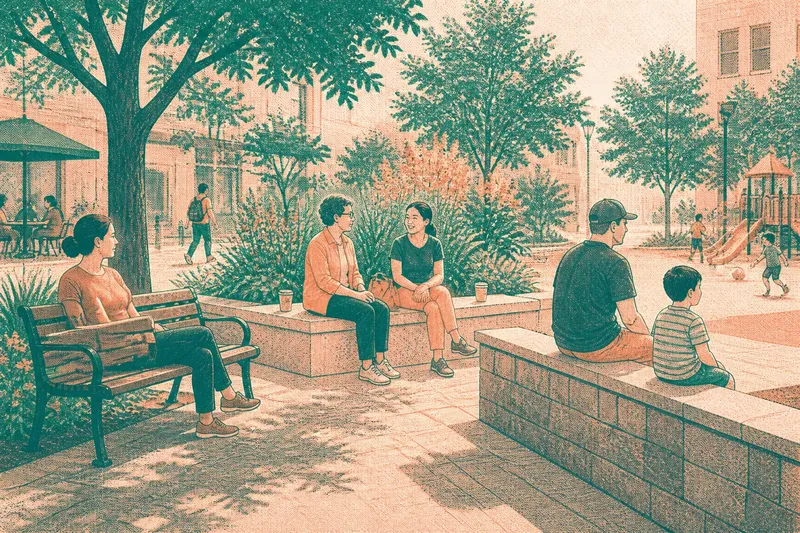
Imagine a small square with a bench beneath a tree, a broad ledge around a planter and a low wall facing a play area. Someone with a tired toddler might choose the bench for its backrest; two neighbours catching up might perch along the ledge; a carer keeping an eye on play might prefer the wall’s clear view. The surfaces do not compete for one ideal use. Their different positions and supports make several kinds of pause possible.
How do you compare comfort, access and company?
Start with the person and the reason for stopping, rather than asking which object is best in general. Someone waiting for a friend may value a clear view of the entrance. A person taking a quiet break may want shade and a little distance from foot traffic. Someone who needs help sitting or standing may prioritise a backrest, armrests and an uncluttered approach.
- Support: Is there a backrest or arm support, or is this a brief perch?
- Approach: Can someone reach the spot along a clear, firm route?
- Room: Can companions sit together without blocking the path?
- Exposure: Is the place shaded, windy, noisy or directly beside passing traffic?
- View: Does the seat face something useful, such as a meeting point, play area or garden?
- Surface: Is the sitting edge broad and stable, or narrow, sloped or damp?
- Shared use: Does sitting here leave room for people walking, wheeling or using nearby facilities?
These are observations, not a scorecard. A bench with a backrest may suit one person and feel too exposed to another. A wall can be convenient for a short wait yet unsuitable for a longer rest. If a space has several options, the best choice is the one that fits the pause without making the route harder for anyone else.
What should you notice about placement?
Where a seat sits can matter as much as its form. Look for shade that lasts through the time you expect to be there, and notice whether a tree, canopy or nearby building blocks the sun. A shaded bench may be a welcome refuge; in a chilly or dim corner, the same cover can make it less inviting.
Check the relationship with movement. Seating set back from a busy path gives pedestrians room and can reduce the feeling of being watched at close quarters. At the same time, too much separation from entrances, lighting or other people may make a spot feel isolated. The useful middle ground varies by place and by time of day.
Sound and view matter too. A low wall beside a fountain may bring the pleasant noise of water, while a seat directly beside a service entrance may collect clattering doors and deliveries. From a bench, a person might see the path ahead; from a ledge, they might face the planting at arm’s length. The view need not be grand. A tree canopy, a patch of moving light or the ordinary choreography of a square can make a pause feel less like waiting in a corridor.
Pay attention to signs of shared use. A stroller parked beside a bench, people sitting at both ends of a wall, or a clear route left around a planter all show how others accommodate one another. That small choreography often says more about whether a place works than the object’s name.
Which place suits a quick stop, a long rest or a meeting?
A ledge often suits a quick stop; a bench may better support a longer rest; and a low wall can serve as a casual meeting edge. Those are tendencies, not fixed rules. The view, approach, nearby activity and needs of the person stopping can easily change the choice.
For a brief pause, a ledge near the route may save a detour, provided it is stable and does not obstruct others. For a longer break, look for a bench with support, a comfortable position and enough space around it. For a meeting, a wall or a bench facing a recognisable landmark can make it easier to spot one another. If several people are gathering, leave a generous path through the space rather than turning a sitting edge into a barrier.
A companion may prefer a different place from the person who planned the stop. One person might need a backed seat while another wants to remain standing nearby. A useful public space offers choices close enough for people to stay together without requiring everyone to use the same kind of seat.
Do benches, ledges and low walls have to be labelled as seating?
No. A bench is plainly a seat, but people also use broad ledges and low walls as informal places to perch. Their suitability depends on the surface, the space around it and whether sitting conflicts with the feature’s intended use.
Can you sit on a planter ledge?
Often, a broad, stable edge can serve as a perch, especially where it does not damage plants or block access. Check for wet soil, sharp edges and signs asking people to keep clear.
Is a low wall comfortable for a long rest?
It may be, but most low walls lack the back and arm support of a bench. If support matters, look for a dedicated seat nearby rather than relying on a hard edge.
Which is easiest to share with a companion?
A long ledge or wall can let people choose their own spacing, while a bench may offer more support for sitting together. Room to approach and pass matters as much as the surface itself.
What if every place to sit is occupied?
Look for another suitable seat or pause somewhere that does not block a doorway, narrow path or accessible route. A public space works best when resting does not make it harder for others to move through.
On your next walk, compare a bench, ledge and low wall in the same square: notice the support, the view and the path each leaves open. Bench, ledge or low wall is not a contest for the most comfortable object; it is a way to see how a public space makes room for different people and different lengths of pause. A place that offers more than one kind of rest lets the city’s everyday rhythm continue around those who need to stop.